There is no single battery size for a home. A phone, a lamp and a router need relatively little power. A fridge needs more over time. A kettle or electric heater can use a large share of a battery in minutes.
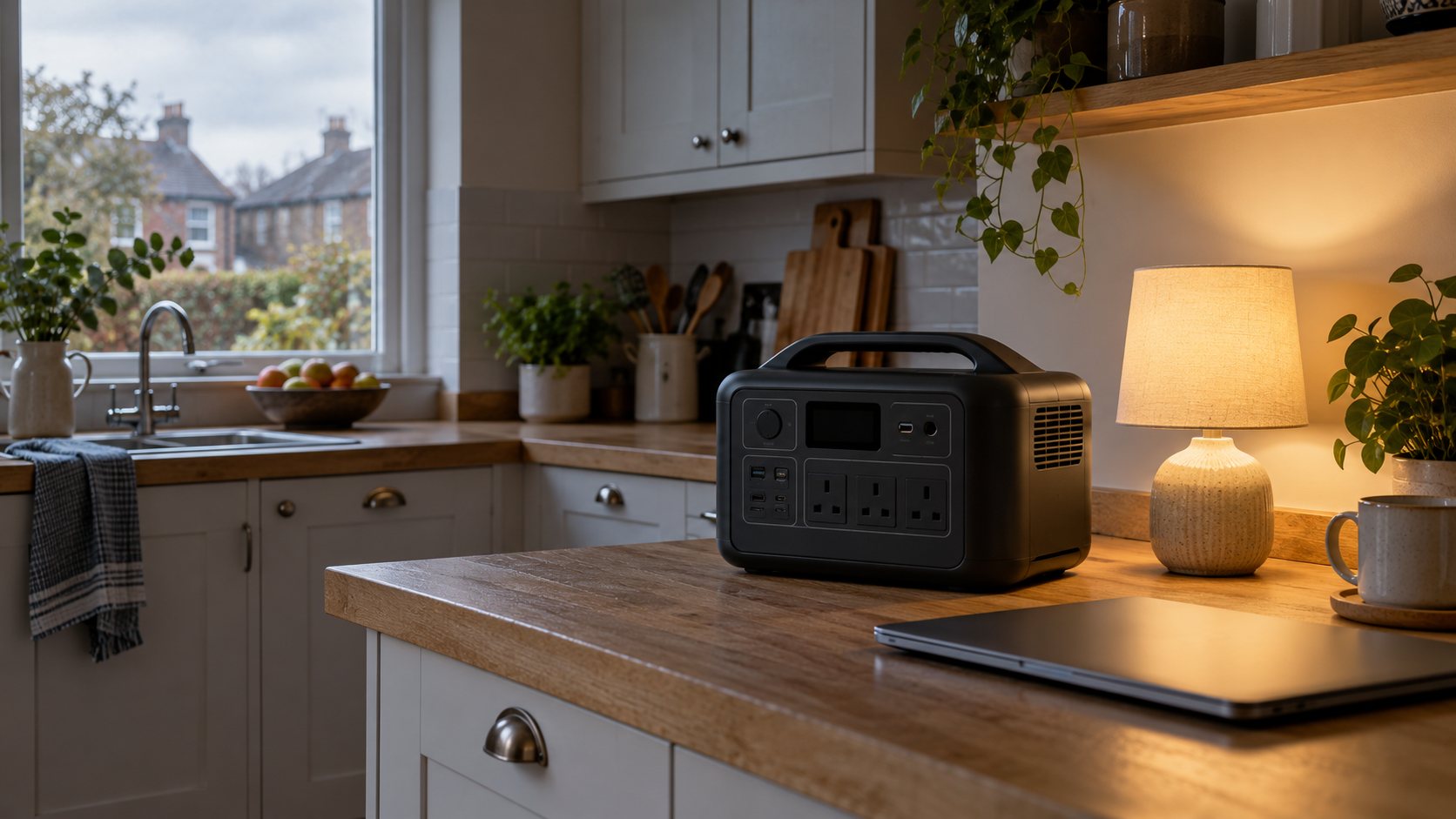
Two figures to understand first
Output, in watts (W), is how much the station can supply at one moment. Add the wattages of everything you plan to run together. A fridge motor may briefly need extra power when it starts, so check the station’s surge rating too.
Capacity, in watt-hours (Wh), is the amount of energy stored. A 1,000Wh battery is roughly 1 kilowatt-hour (kWh). It will not deliver all of that through its mains sockets: the inverter uses some energy, and real appliances vary in demand.
Running time in hours ≈ battery capacity in Wh × 0.8 ÷ average appliance watts. The 0.8 is a cautious planning allowance, not a guaranteed efficiency figure. For example, a 1,000Wh station running an average 100W load might last about eight hours. Check the manufacturer’s measured figures where available.
A practical starting range
| What you want to cover | Capacity to investigate | Output to check |
|---|---|---|
| Phone charging, LED light, radio and perhaps a router | 300–500Wh | About 300–500W may be ample for these small loads. |
| Those essentials plus a laptop, television or occasional fridge use | Around 1,000Wh | Often 1,000W or more, with enough starting surge for a fridge. |
| Fridge or freezer support for longer, plus several small devices | About 2,000Wh or more | Check simultaneous load and compressor starting surge; many units in this class have 1,500–2,000W or more. |
These are shopping ranges, not promises of a particular running time. Your appliance labels and the length of the cut determine the answer. A larger unit also costs more and can be heavy to move.
Work it out for your own home
Write down what matters most, the watts each item draws, and how many hours you expect to use it. Watts multiplied by hours gives watt-hours. Add the results, then allow for conversion losses and a little reserve. A plug-in energy monitor can reveal the actual use of many mains appliances; the rating plate may show a maximum rather than a typical average.
For example, an LED lamp at 10W for eight hours uses 80Wh. A 15W router for eight hours uses 120Wh. A laptop averaging 50W for four hours uses 200Wh. Together that is 400Wh before losses, so a nominal 500Wh station would leave little margin; a larger one would be more comfortable. The router will only provide internet if the broadband equipment and wider network still work.
A fridge is harder to estimate from its running wattage because its compressor cycles on and off. Look at its energy label or measure consumption over a day, then check the brief starting surge. Keep fridge and freezer doors shut during a cut to reduce demand.
What about a kettle, microwave or heater?
A 1,500W kettle needs a station whose continuous AC output can handle at least that load. Ten minutes at 1,500W consumes about 250Wh before losses. A 1,500W heater for one hour uses roughly 1,500Wh before losses. Running a heater through a long winter outage therefore calls for a much larger energy supply than charging phones and providing light.
A microwave’s quoted cooking power is not necessarily its electrical input: inspect its rating label. Air fryers and other cooking appliances also have high draws. Run one demanding appliance at a time unless the combined watts are safely within the station’s continuous output. Do not assume a headline “peak” figure can be sustained.
Before you buy
- Check the continuous AC output, short starting surge, battery capacity, UK sockets and the number of ports you need.
- Check the weight and whether you can comfortably move and store it.
- Think about how you will recharge it. Solar panel output varies with weather and daylight; check panel compatibility and input limits.
- Follow the manufacturer’s ventilation and charging instructions. Plug appliances directly into the station as directed. Never feed power into a household wall socket.
If a medical device depends on electricity, discuss its exact power and backup needs with its manufacturer and your care provider. A general household estimate is not a safe substitute for a dedicated plan.
In short: for lights and communications, a few hundred watt-hours may be enough. Around 1,000Wh is a more flexible starting point for selected household essentials. For a fridge over longer periods, consider roughly 2,000Wh or more and calculate from your actual appliance. Electric heating can exhaust even a large portable battery quickly.