Yes, you can boil a kettle with a portable power station, provided the station can supply the kettle’s required wattage. The catch is that a normal kitchen kettle can demand far more power than lights, phones or a television. A battery that runs those comfortably may still be unable to make your cup of tea.
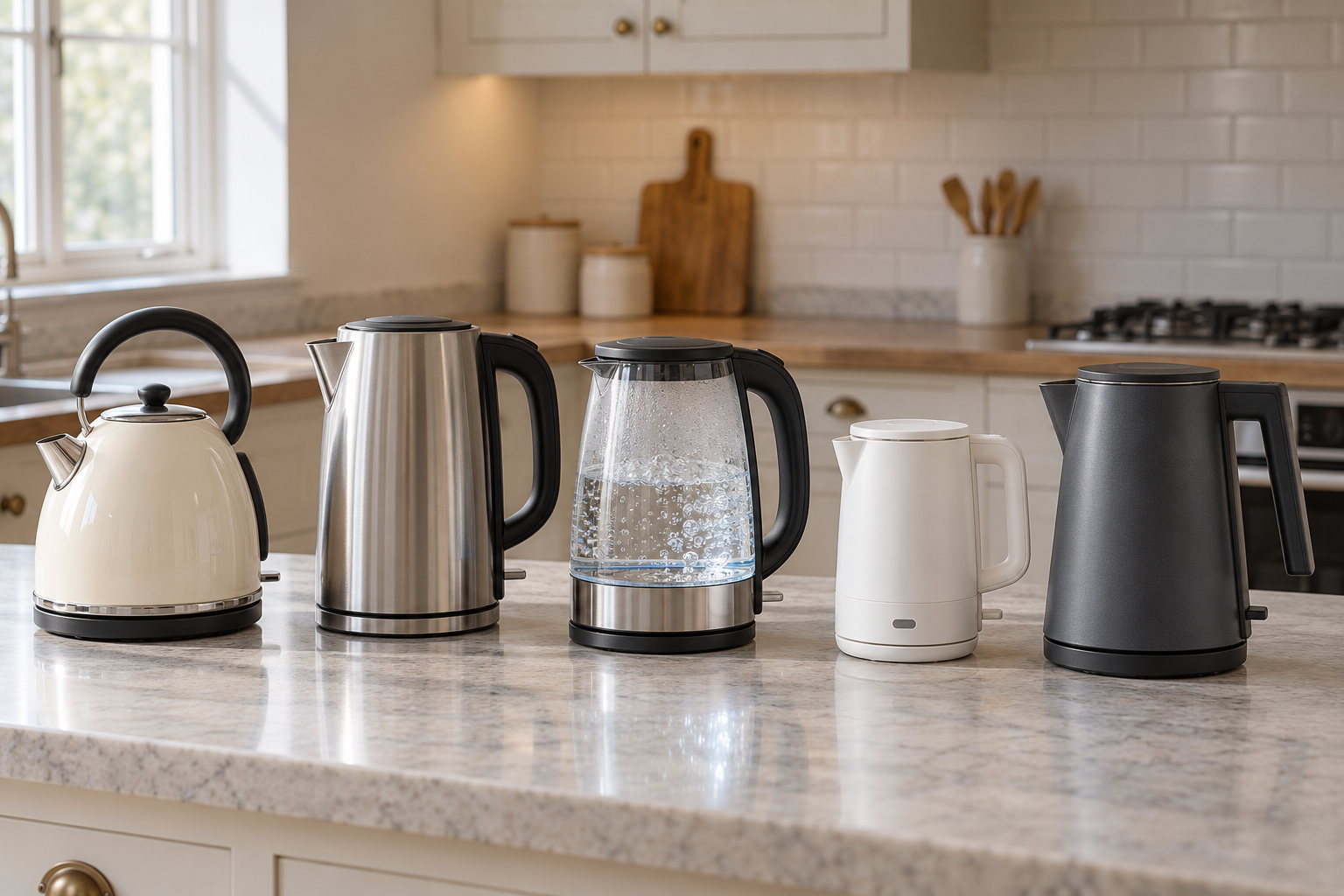
Start with the kettle wattage
Look at the rating label underneath the kettle or its base, or check the manual. Many UK kitchen kettles are rated around 2,000–3,000W. For example, Russell Hobbs lists its Cream Inspire kettle at 3,000W. The shape or size of a kettle does not reliably tell you its power requirement.
Compare that figure with the power station’s continuous AC output in watts. A 3,000W kettle needs a station rated to supply at least 3,000W continuously when used normally. A 2,000W station cannot normally run it at full power, even if the battery holds 2,000Wh.
Do not confuse watts with watt hours
Watts describe how much power the station can deliver at one moment. Watt-hours describe how much energy its battery stores. You need to check both.
Imagine a station with a 1,000Wh battery but only 1,000W of AC output. It may store enough energy for several boils, yet it cannot normally power a 3,000W kettle. A larger battery does not automatically mean a stronger AC outlet.
A lower wattage kettle can be easier to run
A kettle rated at 700–1,000W can be a practical match for a smaller power station, provided its continuous output comfortably covers the kettle and any other connected appliances. Check the actual rating before buying: a small travel kettle is not necessarily low wattage.
A lower wattage kettle will usually take longer to heat the same amount of water. It does not automatically use much less battery energy, because it runs for longer. Its main advantage is the lower demand on the station’s output.
How much battery does one boil use
You can estimate appliance energy by multiplying watts by running time in hours. A 3,000W kettle running for three minutes uses about 150Wh: 3,000 × 3 ÷ 60. A 1,000W kettle running for nine minutes also uses about 150Wh.
These are examples, not measured boiling times. The actual figure depends on how much water you heat, its starting temperature, the kettle and heat losses. The power station also uses some energy converting battery power to mains electricity.
How many times could you boil it
Suppose a fully charged station has a 1,000Wh battery and, for planning, 85% of that energy reaches the appliance. That gives 850Wh. If each boil uses 150Wh, the calculation gives about five complete boils, with some energy left over.
A 2,000Wh station gives about eleven complete boils under the same assumptions. Real results can be lower, especially with other appliances connected, a partly charged battery or different conversion losses. These calculations assume the station has enough continuous output to run the kettle in the first place.
Boil only the water you need
Heating a smaller quantity of water usually saves more energy than simply choosing a slower kettle. Follow the kettle’s minimum fill line and never run it dry. For a couple of drinks, there is little reason to fill a large kettle to the top.
If you expect another drink soon, a suitable insulated flask can keep spare hot water warm. During a long power cut, consider whether the battery should be saved for the fridge, freezer, lighting or communication before repeatedly boiling water.
Check boost modes carefully
Some stations offer a special mode that can run certain heating appliances above their normal rated output. That is different from a brief surge rating, which does not cover several minutes of boiling.
Compatibility and performance depend on the particular station and kettle. Follow both manufacturers’ instructions and do not assume a headline boost figure means normal full-power operation. Choosing a kettle within the continuous output rating gives you a simpler arrangement.
Set it up safely before a power cut
Use the station’s UK-compatible AC socket and the output type specified by the manufacturers. Keep the kettle on a stable counter and put the station away from splashes, steam and the sink, with its ventilation clear. Arrange the cable so it cannot pull either item off the counter.
Account for all appliances sharing the station’s total output. A kettle plus a microwave or heater can overload a setup that runs each separately. Never connect the station’s AC output to a household wall socket to feed the home’s wiring.
Try one supervised boil while mains power is available. Check that the station runs the kettle without an overload warning and note the battery used. If protection trips, switch off and check the manuals rather than repeatedly trying the same overloaded arrangement.
Choose the kettle and station together
If you want to use your existing kettle, start with its wattage and choose enough continuous output to cover it, with room for anything else you will run. If you already own a smaller station, a genuinely lower wattage kettle may be the more practical choice.
A portable power station can make a welcome cup of tea during a power cut. The useful checks are straightforward: enough output to run the kettle, enough stored energy for your needs, and only as much water as you intend to use.