A portable power station can keep a few important parts of home life going when the electricity goes off: a lamp, your phone, perhaps a laptop, and a suitable fridge or freezer. What it can run depends on its power output, its battery capacity and the appliances you connect.
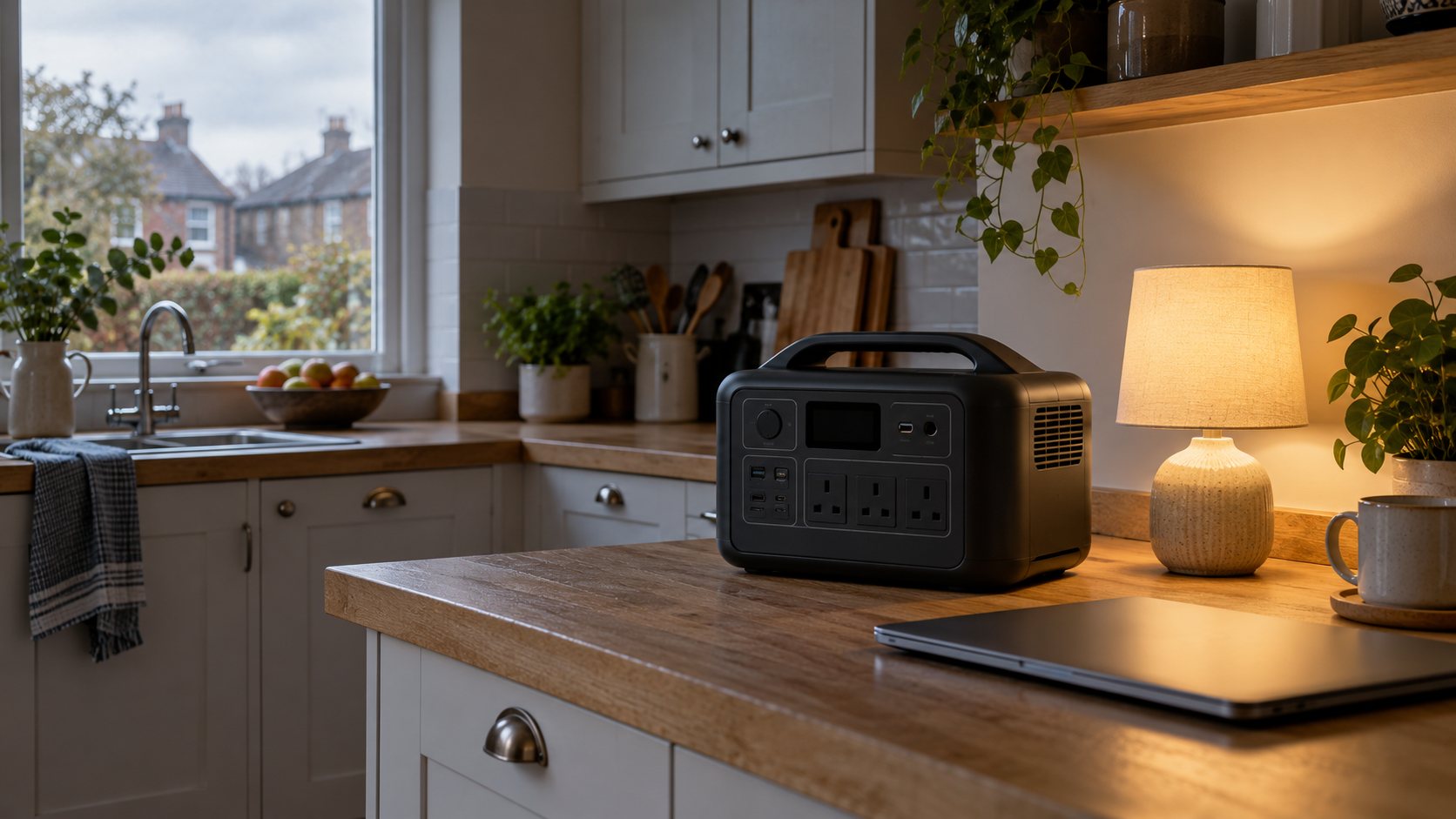
Start with the things you need most
For a short power cut, light and a charged phone may be all you need. For a longer interruption, keeping food cold or using a laptop may become more useful. Think about those priorities before trying to run everything you normally use.
An ordinary portable power station supplies the equipment plugged into its own sockets and ports. It does not automatically supply your home’s ceiling lights, wall sockets or central heating.
Two numbers decide what you can run
Watts (W) describe how much power an appliance needs at a particular moment. The station’s continuous output must cover the total demand of everything running together. A fridge or freezer may also need a brief burst of extra power when its compressor starts. Check that starting demand against the station’s supported surge output.
Watt-hours (Wh) describe the energy stored in the battery. More watt-hours usually mean longer running time for the same equipment. A high output rating does not, by itself, mean a large battery. Check both figures, including any separate limits on individual sockets or USB ports.
Everyday appliances at a glance
The figures below are illustrative planning ranges, not measurements of your appliances. Check the rating label, manual or a suitable plug-in energy monitor. Some labels show maximum input rather than normal average use.
| Appliance | Illustrative power | What to check |
|---|---|---|
| LED lamp | 5–15W | A useful low-demand essential |
| Phone or tablet charging | 5–30W | Charging draw changes; check port compatibility |
| Router and fibre terminal | 10–25W combined | Internet also depends on the wider network |
| Laptop | 30–100W | Demand varies with use and charging |
| Television | 40–150W | Size and settings make a difference |
| Fridge or freezer | 50–200W while compressor runs | Starting surge and daily energy use matter |
| Electric blanket or heated throw | 40–150W | Check its label and safe-use instructions |
| Kettle | 1,500–3,000W | High output needed for a short period |
| Microwave electrical input | 1,000–1,600W | Input exceeds the quoted cooking power |
| Air fryer | 1,000–2,000W | Cooking time affects energy consumed |
| Small fan | 20–60W | Check its speed setting and actual rating |
| Slow cooker | 100–300W | Long cooking time adds up |
| Toaster | 800–1,800W | High draw even for a brief use |
| Electric room heater | 1,000–2,500W | Can drain a battery quickly |
Lighting and phone charging
LED lamps and phone charging are useful places to start because their demand is modest. Use the station’s compatible USB ports for phones where possible, and switch off outputs you are not using, as directed by its manual.
Choose a plug-in LED lamp or a compatible USB light. Fixed ceiling lights will stay off unless your home has a properly installed backup system. A rechargeable torch is useful for moving between rooms without trailing cables.
Phones, tablets and e-readers usually need relatively little energy. Use a compatible USB port and the correct cable; a USB-C laptop may need a higher-powered USB-C PD port. Fast charging is limited by the device, cable and port. Once a phone is charged, unplug it and keep some battery in reserve for calls and messages.
TV and Wi-Fi
A modern television can often run from a suitable station for several hours. Screen size, brightness and picture mode affect demand, so check the actual model. Include the consumption of any set-top box, streaming stick, games console or soundbar in your total.
For example, a TV averaging 75W uses 300Wh over four hours, before the station’s conversion losses. Watching for a shorter period or using a tablet can leave more energy for food storage and lighting.
A router may run from the battery, but that does not guarantee internet access. Full-fibre broadband normally also has a separate optical network terminal, or ONT, that needs power. BT’s backup guidance covers both the hub and this fibre box. Your provider’s wider network must still be working. Streaming TV and digital landline calls can be affected if that connection fails, even when your own equipment is powered.
Keep a charged mobile phone available as another way to stay in touch, although mobile service can also be disrupted. Use equipment’s supplied mains adaptors unless the manufacturer approves a direct DC connection with the correct voltage, connector and polarity.
Running a fridge
Often you can, provided the station can handle both the running load and the compressor’s starting surge. Check compatibility before relying on it, and test the arrangement while mains power is available.
A fridge cycles on and off, so dividing battery capacity by its running wattage can give a misleading estimate. Measuring its energy use over a day is more helpful. Room temperature, door opening, defrost cycles and the appliance’s age all affect consumption. Keep the doors closed as much as possible during a power cut. Check whether the station’s automatic shutdown settings are suitable for an intermittent fridge load.
For a rough energy estimate, divide the fridge’s annual energy-label figure in kWh by 365, then multiply by 1,000 to get Wh per day. A label showing 180kWh per year works out at about 493Wh per day under the label’s test conditions. Your home’s actual use can differ substantially, so a plug-in monitor over a representative day is a better guide.
Running a freezer
A separate freezer has the same two requirements: sufficient continuous output and enough starting power for its compressor. Its energy use must be added to the fridge’s if both are connected. Allow for either compressor starting while other appliances are already running, and for defrost cycles on frost-free models.
During a short power cut, leaving the freezer shut may be more useful than immediately spending battery energy on it. Food Standards Agency guidance estimates that an unopened fridge can stay cold for up to four hours, and an unopened freezer can keep food frozen for up to 48 hours when full, or 24 hours when half full. These are estimates that vary with the appliance and room temperature.
Use a thermometer to monitor food-storage temperatures and follow the Food Standards Agency’s power-cut guidance when deciding what is safe to keep. Connecting a battery later does not make food safe again if it has already been stored too warm.
Using a microwave
A microwave can be useful for reheating a meal quickly, provided its electrical input is within the station’s continuous output rating. The cooking wattage on the front is lower than the electrical input. For example, Panasonic lists 800W cooking power and 1,250W power consumption for its NN-ST23QMBPQ model.
Check the rating label or manual, and allow headroom for anything else connected. On some microwaves, a low cooking setting cycles the full-power draw on and off, so reducing the cooking setting does not guarantee that a smaller station can run it. Grill and convection modes can draw more power.
As a calculation example, 1,250W for five minutes uses about 104Wh before losses. Follow the food’s cooking instructions and make sure it is heated thoroughly.
Boiling a kettle
A kettle can run from a sufficiently powerful station, but an ordinary UK kettle may require up to 3,000W. A station rated for 2,400W continuous AC output cannot normally run a 3,000W kettle at full voltage. Check continuous output rather than assuming a surge or boost figure makes it compatible.
A lower-wattage kettle may fit the output limit, although it takes longer and does not necessarily use much less energy to boil the same amount of water. Boil only what you need while respecting the kettle’s minimum fill level. A vacuum flask can keep an earlier boil hot for later drinks.
For illustration, a 1,500W kettle running for three minutes uses 75Wh before losses; the time depends on the water quantity and starting temperature. Putting less water in a kettle shortens the boiling time, but does not reduce its instantaneous power demand.
Air fryers and other common appliances
An air fryer, toaster, coffee machine or slow cooker may work if its input stays within the station’s rating. Air fryers and toasters can need a lot of power; slow cookers may draw less at any moment but run for many hours. Include the complete cooking time in your energy plan.
A 1,500W appliance running for ten minutes uses 250Wh before conversion losses. That may be reasonable for an occasional hot drink or a quick meal, but several cooking sessions can make a noticeable dent in the battery. Run demanding appliances one at a time unless the combined load is comfortably within the station’s continuous output rating.
Laptops, radios and small fans are often manageable loads. A vacuum cleaner, hairdryer or iron may need a much higher output. Washing machines and dishwashers can have substantial heating loads and long cycles, making them lower priorities during a power cut. A central-heating boiler normally needs electricity, but powering fixed boiler wiring requires suitable professional installation.
What about keeping warm
An electric room heater is one of the hardest loads for a portable battery. A 1,500W heater running continuously for one hour uses 1,500Wh before losses. Even a sizeable battery can therefore be exhausted quickly.
An electric blanket or heated throw generally needs far less power and may be a practical way to keep one person warm. Check its actual rating, compatibility and safety instructions. A thermostat can reduce average consumption, but the station must still handle the appliance’s full draw when heating is on.
A simple running time example
Imagine a fully charged 1,000Wh station powering a 10W LED lamp, a 15W router and a television averaging 75W. Together they draw 100W. If you allow 20% of the nominal battery capacity for losses and reserve, the estimate is 1,000 × 0.8 ÷ 100 = about eight hours.
Adding a 1,500W kettle to that 100W load brings the instantaneous demand to 1,600W. Both output and energy matter: a large battery with only 500W AC output still cannot run that kettle. Stop other loads where necessary and keep some energy for essentials.
This is a planning example, not a promised running time. Inverter overhead, battery condition, temperature and changing appliance demand affect the result; small loads can be particularly sensitive to the station’s own power consumption. Manufacturer runtime tests and your own trial are more useful for a final plan.
Connect equipment safely
Plug appliances into the station as its manufacturer directs. Never connect its AC output to a household wall socket to feed electricity into the house. Supplying fixed wiring requires an appropriate professionally installed system.
Keep the unit dry, leave its ventilation openings clear and follow its charging instructions. If using an extension lead, follow both manufacturers’ guidance, stay within the lead and station ratings, avoid linked extension leads and fully unwind a cable reel. Keep cables away from walkways.
For equipment essential to health, arrange a specific backup plan with the equipment supplier and your care provider. Do not assume that an ordinary station’s emergency power or UPS feature provides an uninterrupted or medically suitable supply.
Make a small plan before the next power cut
Write down the few appliances you would most like to use, check their input power and decide how long you need them. Then check the station’s capacity, continuous output and starting surge against that plan.
A portable power station can make a power cut much easier to manage. It is most useful when you spend its stored energy deliberately: light, communication, food storage and a little comfort, with enough reserve for the things that matter most.